Saturday, May 15, 2010

Ruined Weekend #3

The next thing I knew I was looking up from the dirt floor on the inside of a very strange
building, house or, as I later found out, replica of an ancient Inca home.

The sturcture's trapezoid design enabled it to withstand the many common earthquakes that occurred in the region. As you can see here, that peculiar geometric design was even carried through to the windows.


I would tell you what happened on my magical mystery tour, but I don't know.
What I did know was that the sun was out, the fog had lifted and I felt a compelling desire to inspect the strange constructions that these first masons had built 700 years ago.


While these waiting rock/bricks seemed to be arranged in a staging area of some kind, I suspect there was a deeper, more religious purpose, but really have no idea.

And you thought tight fireplaces were impressive!

On the one hand, I wish more remained to inspect; but on the other it probably would have been too much, sensory overload.

All I can say is you couldn't squeeze a slip of notebook paper it between these rocks if you tried.

In many ways, these were their stairways to heaven.

No mud, adobe, concrete, anything!
Just rocks for ages which even earthquakes couldn't make roll.

Here's the head priest's corner office without a view.

Well, there probably were views at one time, but not today.


Last and least, one of those telling height differential images to put it all in scale.
See ya later, gators...

Thursday, May 13, 2010

Ruined Weekend #2


Before you ask, I have no idea what the name of this tree is; but the indigenous people believe it has the ability to keep evil spirits away and, so, it is planted at the entrance of most sacred sites.
This is the second day of our weekend visiting ancient ruins and this is the famous Ingapirca where today it's raining buckets.

That was just fine with the holy land's permanent herd of llamas because it only made the high grass sweeter which the baby really liked and jumped around for more and more.

Like all sacred structures, this one was also built on the local area's dominant hill.
The closer you can get to heaven, the more likely HE/SHE/IT will be able to hear your supplications being the widely accepted reasoning for this common world-wide occurance.

Why the divergent paths to nowhere? Not being an archeologist, I have no idea; but they were interesting to speculate on and they didn't deter Fernada Llama from going anywhere he darn well pleased.

Well, the wierd upside-down tulip tree might be keeping the evil spirits away, but it didn't keep the creepy feelings away as we walked up the hill towards the Inca Temple.

Funny, but it wasn't as foggy on top when I looked back down on the enigmatic half-circle path.
Maybe, because this was the Sun God's crib and that still isn't allowed up here.

No, check that, it's just part of the wierdness. It's foggy, then it's not, then it is, then it's not.
I think I'll just pretend like it's not even happening until I get out of here.
The most amazing thing about these buildings is how tight the bricks are and they stay that way without any kind of mortar or adobe. I'll show you examples of their exactness in upcoming photos.
There were lots of informational markers along the paths explaining the purposes of the various rooms you see here; but it was such a miserable, chilling downpour we were being chased off the hill in more ways than one .

The holes in these rock all had functions

like holding different important liquids, including blood,

but to me they seemed more like Fred Flintstone's bowling ball.
So, I thought I'd just put my fingers in one and
~ poof ~

Tuesday, May 11, 2010

A Ruined Weekend

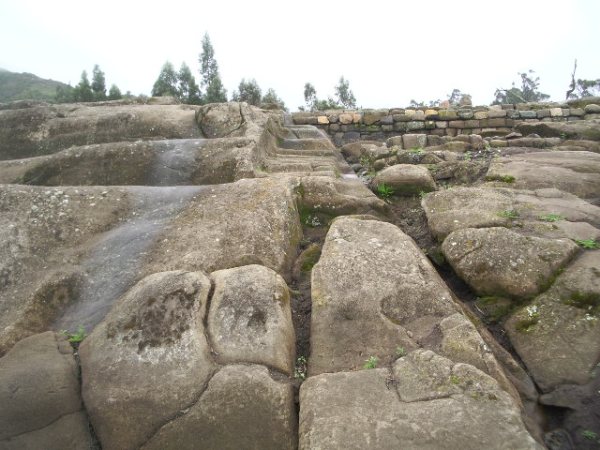
It was cold and rainy when we arrived in El Tombo, so Jo and Meg haggled over and purchased two very nice hooded, polar fleece frocks for only $14. Here you see the Sisters of Perpetual Anguish escorted by their native guide, Rosa, on the path to the bath, Banos de Coyoctor, a Santuario Inca. Even though it may now be referd to as an Inca Sanctuary, these carved rocks were well worn before that better known race came and conquered the native people. The Canari had been worshipping their Sun God on this hillside for so long before hand their leather soles had worn out steps into the rock faces.
The Canari (400-1532) are a Pre-Columbian race (read that before Christopher Columbus) and were already an advanced civilization here in Central Ecuador when the Inca marched up from Peru.

Today, the path they took North is known as the Inca Trail or Ruta Inka, but the Canari had established it originally. The Inca simply used it to expand their empire.

The average altitude here is 3160 M (10,368 ft.) with some hills? reaching 3806 M (12, 487 ft.). The really high peaks are the many snow-capped vulcans that make up the north-south runing avenue of the volcanos. - Jo just called me from the rim of one of those, so we should have some spectaculor shots to share when she returns...if she doesn't fall in trying to compose the perfect image. - Other statistics for the region are an average temperature is 54 degrees, a population of around 58,000 in an area of 1800 KM2 (700 sq. miles).


The Inca conquered many native groups, but the Canari never lost their ethnic identity. In fact, when the Spanish Conquistators came in 1530 the Canari viewed them as liberators from Inca tyranny and joined them in wiping the pushy Peruvians off the face of the Earth.

The Sun God, Raymi, is worshipped with a Summer Solstice festival, Killa, even today. Although they have done away with the sacrificing of vestial virgins by buring them alive, much to Rosa's relief. The earthly King would sit in the bath carved into these rocks and fresh water would cascade down from above warming in the June sun in order to cleanse and purify him before addressing the gathered multitudes.


Quick! Somebody cue the llama!


If you're a builder, note the soffett construction of bamboo.


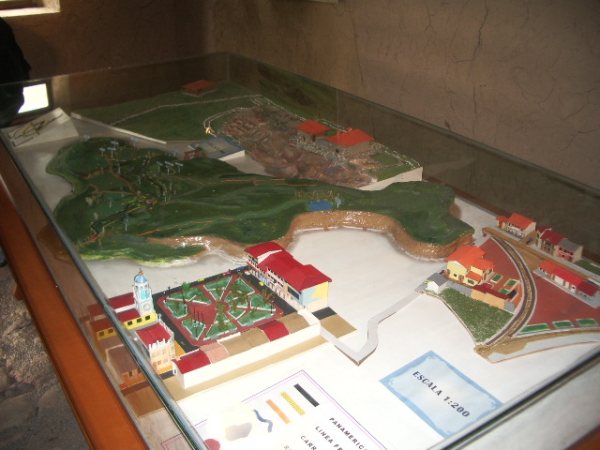
This then is the obligatory, omni-present "Tourist Information" center Rosa's local government maintains for us, the picture-taking, jabbering gringos. It is complete with a scale model;


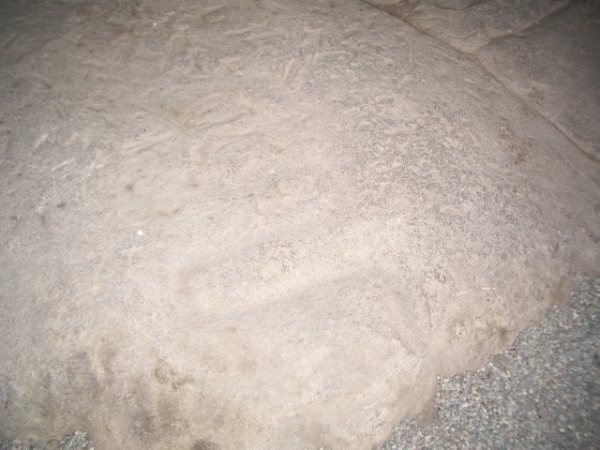
very old, serpent petroglyph;


height differential demonstrations;


and various life-sized, cultural dioramas with costumed re-enactments of important holidays and practices.
Here's a shot I took earlier this year on the streets of Cuenca of this guy's descendant still partying on.

This is Grandpa making a little home-brew and wearing the little white bowler the Canari are recognized by.

Mom is sewing the corn behind Dad with his wooden plow and imaginary oxen (Ministry of Tourism budgetary considerations, don't cha know) as they till and plant the Andean rocky soil.

This is interesting in that I saw the same venerable street scene in Moscow, Russia. That being a guy with a chained, wild bear and a collection cup. Call it archtypal Man's early attempts at "Another Roadside Atraction". N.B. about the spelling mistakes...I haven't found a good English dictionary yet, principally I'm am against spellcheck and I'm too lazy to stop, so there.

Not that you can read it, but here is a bilingual posture explaing why it is O.K. for someone to chain up a bear and walk around collecting money from those wiling to donate of which I am not one.

Well, time to go teach my 15 YO's English and that most Americans are just like me.
Chau,
Tony

Monday, May 10, 2010

All Aboard !!!!!!!!!!!!!!!


O.K., this entry goes out to my closet railroad engineer friend. I'm talking to you, Dick Puller. Last weekend we went to a little town called El Tombo or something like that. Joining us was a new friend, Meg from England. She's English and she teaches English. Now there's some built in authenticity, eh wat. That's her and Joella at the railway station buying tickets for our little train ride.

And here's our ride, the little train that could. It had a Ecquatorian crew of three and an equal number of passengers, two Yanks and a Brit.


It had a round-a-bout on each end of the line and the trip was thirty minutes long and I seriously doubt we ever broke thiry miles an hour. The destination (and it was the only one) was the site of some Canari ruins. The Canari were here long before the Incas.


This little store was across from the station and in front of one of the turn-a-rounds.


This was one of the uglier churches I've seen so far and the highlight of El Tombo's town square.


Here's one of the covered porticos around the square. Notice how it's adorned with a Donald Duck trash can. Possibly part of some third world funding made posible by Disney Corp.

Here's a bug's eye view before impact of our ride.

Railroads of Ecuador

Well, we hadn't gone too far when the engineer spots something suspicious on the track he just drove over and so he sends one of his more qualified crew members out to hand sweep it off the rail. After all, we'll be going back the same way and the debris will probably still be there, so let's sweep it off now and avoid a derailment. Ya sure, as they say in Ballard.


Rolling through the countryside is the part you would have liked best, Engineer Dick.


Plus, all kinds of wildlife along the line.

We arrive at our destination and disembark for the short jaunt to the ruins. The train crew assures us they have nowhere elese to go and will still be here waiting when we've finished with our little look-see.

Oh, and we won't be alone because Rosa, our tour guide, has been waiting for us (or ANYONE) to come along so she could get out of the shack and walk around a bit. Rosa enthusiastically tells us all about the ruins and their history. Of course, it would have been much more informative if we spoke Spanish, but that's hardly Rosa's fault. The locals call the foriegn vistors "extraterraneos" (sp?), but I refer to us as extraterrestials which a few of them on hearing seem to enjoy. Anyway, we three said Si, Si, Si to everything Rosa shared with us and it was a grand afternoon. That Brit's starting to rub off on me.

This was the site of the Royal Baths.


There will be more pictures of the ruins later, this posting was to be about the train ride,
Hang in there.


The countryside on the return trip.


There were a lot of farmyard animals, from tied up sheep to free range chickens on or near the tracks for most of the trip, but, generally, it seemed to be a symbiotic relationship between mammals, fowls and machine.

This shot doesn't show it very well, but there was quite a bit of very nice woodwork of the train such as the overhead roof protecting the back porch of the caboose.
So, Ill leave you now with a fond farewell and the immortal words of Satchel Page,
"Never look back, they might be gaining on you."

The train I ride...sing it Boys!